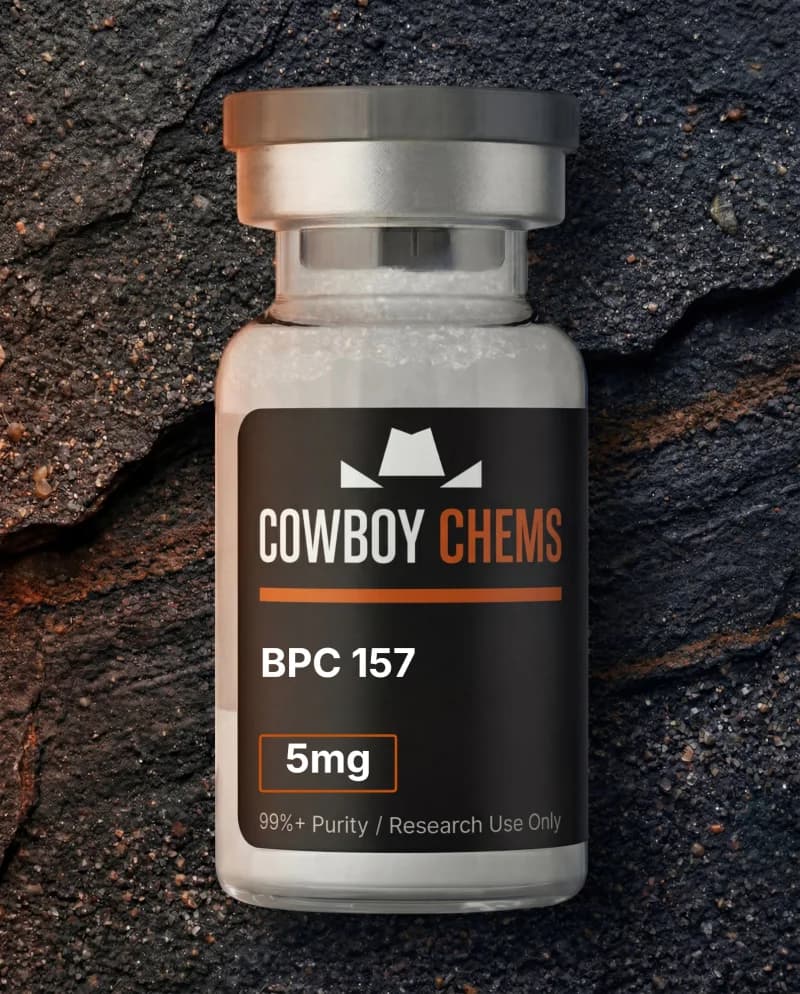
BPC-157 — Body Protection Compound-157 — is a synthetic pentadecapeptide built from 15 amino acids in the sequence Gly-Glu-Pro-Pro-Pro-Gly-Lys-Pro-Ala-Asp-Asp-Ala-Gly-Leu-Val. Published structural work locks in the molecular formula as C₆₂H₉₈N₁₆O₂₂, molecular weight 1419.53 g/mol, CAS number 137525-51-0 (PMID: 30915550). The peptide originates from a partial sequence of a protective protein native to human gastric mucosa. Three consecutive proline residues at positions 3, 4, and 5 — plus a fourth at position 8 — impose geometric constraints that shape receptor interactions and limit metabolic degradation. Glycine anchors the N-terminus; valine closes the C-terminus. NMR spectroscopy in published studies shows BPC-157 taking on a partially helical conformation in aqueous solution, with the central stretch more ordered than either terminus. Production follows standard solid-phase peptide synthesis via Fmoc chemistry, with preparative HPLC purification and lyophilization delivering a white to off-white powder that dissolves readily in water and aqueous buffers.
What is the origin of BPC-157?
BPC-157 traces back to a protective protein first isolated from human gastric juice. Early investigators hunting for cytoprotective factors in gastric mucosa identified a protein fraction with measurable protective activity in tissue models, then worked backward to find the minimal active sequence — the 15-residue fragment we now call BPC-157. The name "Body Protection Compound" was not marketing copy; it reflected the literal research context, a class of gastric-derived compounds that buffer tissue against injury. Historical documentation places the core discovery in the early 1990s, with initial publications characterizing isolation and cytoprotective behavior in gastric tissue models. What makes BPC-157 unusual among synthetic peptides is that it copies a sequence naturally occurring in human tissue rather than engineering a novel structure from scratch. Published molecular biology work confirms the synthetic version matches the native fragment's physicochemical properties with high fidelity — you are working with a documented reproduction of a real biological signal, not a designed artifact.
What are the published mechanisms of action for BPC-157?
BPC-157 operates through several interacting pathways, and the published data covers a lot of ground. The nitric oxide system gets the most attention: studies in endothelial cell cultures and gastric tissue models show BPC-157 modulating eNOS activity, which feeds into NO production that governs vascular tone and blood flow. The GABAergic system is also in play — in vitro work in neuronal cultures documents effects on GABA-A receptor function and chloride channel conductance. Dopaminergic pathways shift too, with changes in dopamine synthesis and receptor activity recorded in cell culture models. Growth factor signaling — specifically VEGF and FGF pathways — is well documented, affecting cell proliferation and migration in tissue culture studies (PMID: 30915550). Add prostaglandin system modulation, NO-cGMP pathway activity, and calcium signaling to the list. No single mechanism dominates the picture; the compound appears to function as a multi-target modulator rather than a precision-targeted single-pathway agent.
What does published research show about BPC-157 and nitric oxide?
The BPC-157 / nitric oxide relationship is one of the better-characterized pieces of this compound's published science. Research in endothelial cell cultures shows BPC-157 altering eNOS expression, which feeds directly into NO production governing vascular function. The NO system handles vascular tone, blood flow regulation, and a wide range of cellular communication events — so anything moving eNOS has downstream consequences worth tracking. Gastric tissue model studies show BPC-157 influencing NO-mediated protective responses, consistent with its origin from gastric-derived protective proteins. The mechanism appears to include both enhanced NO synthesis and stabilization of available NO in tissue preparations. Further downstream, BPC-157 engages the NO-cGMP pathway: cyclic GMP production shifts in response, and that change propagates into smooth muscle relaxation, platelet aggregation dynamics, and cellular stress signaling. The overall picture from published mechanistic studies positions NO pathway modulation as a primary mechanism — not peripheral to what BPC-157 does, but central to it.
How does BPC-157 affect growth factor pathways?
Growth factor pathway modulation is documented across multiple published studies and covers three major systems: VEGF, FGF, and EGF. In fibroblast and endothelial cell cultures, BPC-157 alters VEGF expression and VEGF receptor signaling, producing shifts in angiogenic behavior in vitro. VEGF-A production increases in cellular models, with implications for vascular formation and remodeling. FGF-2 signaling receives comparable attention: fibroblast proliferation and extracellular matrix output both change, mediated through FGF receptor activation and downstream MAP kinase cascades. The EGF side of the picture shows BPC-157 affecting EGF receptor phosphorylation and downstream signaling, measurable in scratch assay wound closure experiments in epithelial cultures. Published molecular analyses frame these effects as a coherent mechanism through which the compound influences cell proliferation, migration, and tissue remodeling responses (PMID: 30915550). These pathways sit at the intersection of tissue repair, angiogenesis, and cellular stress responses — which is why BPC-157 keeps appearing across research categories that seem separate on the surface.
What is known about BPC-157 and neurotransmitter systems?
BPC-157's published footprint in neurotransmitter research covers three systems — GABA, dopamine, and serotonin — with GABA and dopamine showing the most developed data. In neuronal cell cultures, BPC-157 affects GABA-A receptor function: chloride channel conductance shifts, and GABA receptor subunit expression and trafficking change in cellular models. The dopamine picture shows modulation of synthesis, release, and receptor activity in neuronal cultures, extending to dopamine transporter function and receptor signaling. Serotonin system interactions exist in the literature but remain less characterized than the GABA and dopamine findings. Published work also points to effects on monoamine oxidase activity in biochemical assays, suggesting BPC-157 may influence how fast neurotransmitters are cleared rather than only how they signal. The honest framing here, consistent with published conclusions, is that all of these findings come from cell culture and biochemical models. The mechanisms are worth knowing for anyone designing neuronal research protocols, but they require further validation before stronger interpretive claims are justified.
What is the amino acid sequence of BPC-157?
The full sequence is Gly-Glu-Pro-Pro-Pro-Gly-Lys-Pro-Ala-Asp-Asp-Ala-Gly-Leu-Val, a 15-residue linear arrangement. In single-letter notation: GEPPPGKPADDAGLV. Published structural studies have confirmed this sequence via mass spectrometry and Edman degradation. A few architectural features are worth noting for anyone interpreting the data: the Pro-Pro-Pro stretch at positions 3-5 locks in structural rigidity at that region; multiple acidic residues (Glu, Asp, Asp) govern solubility and charge behavior; hydrophobic residues (Leu, Val, Ala) balance hydrophilic ones. Glycine at the N-terminus is flexible; valine at the C-terminus provides a hydrophobic anchor. No cysteines — no disulfide bonds to worry about, which simplifies synthesis and handling considerably. Published conformational studies using circular dichroism show BPC-157 cycling between random coil and partial helical conformations in solution, with the proline-rich section possibly adopting polyproline-type geometry. Synthesis itself is achievable via solid-phase methods with high sequence fidelity, though the triple-proline run requires careful coupling to prevent incomplete reactions.
How does BPC-157 interact with cellular stress responses?
Cellular stress response pathways — oxidative stress, ER stress, mitochondrial function — all show documented BPC-157 interactions. In epithelial cell cultures, the compound influences antioxidant enzyme expression for both superoxide dismutase and catalase, producing measurable shifts in cellular redox status. Reactive oxygen species production and scavenging both change in oxidative stress models. Heat shock protein expression — HSP70 and HSP90 specifically — shifts in cellular stress models; these chaperones handle protein folding and protect against stress-induced structural damage. The unfolded protein response is also engaged, with endoplasmic reticulum stress markers moving in response to BPC-157 treatment in cell culture. Mitochondrial studies are part of this picture too: membrane potential and ATP production change, and mitochondrial biogenesis markers and dynamics shift in cellular models. Taken together, these stress response interactions give mechanistic grounding to the cytoprotective activity repeatedly observed in tissue culture work — the compound appears to engage multiple parallel protective systems rather than leaning on a single mechanism.
What research applications does BPC-157 have?
The published applications catalog for BPC-157 is wide. Gastric tissue research uses it to probe protective mechanisms against chemical injury and oxidative damage in mucosal cell cultures — fitting given the compound's origins. Wound healing research applies it to fibroblast migration, collagen synthesis, and angiogenesis investigations in tissue culture. Vascular research examines endothelial cell function, angiogenic responses, and vascular remodeling in vitro. Neuroscience applications use it to interrogate neurotransmitter modulation and neuronal stress responses. Tendon and ligament research investigates connective tissue cell behavior and extracellular matrix production. All of these are preclinical applications — cell cultures, tissue explants, biochemical assays — not controlled clinical investigations. The practical requirements for this work are consistent across applications: high-purity compounds with sequence verification and analytical documentation including HPLC purity and mass spectrometry identity. Published protocols typically run 1-100 μg/mL in cell culture media, with duration scaled to experimental design.
What is the current state of BPC-157 research?
The BPC-157 literature is predominantly preclinical — cell cultures, tissue models, biochemical assays — and published review articles are honest about what that means. Mechanistic work has mapped multiple pathways: NO modulation, growth factor signaling, neurotransmitter interactions. Effects are documented across gastric, vascular, and neuronal tissue culture models. What the literature does not yet have is large-scale randomized controlled investigations that would shift these findings from promising to definitive. Review authors consistently call for standardized protocols and independent replication. Some published studies carry methodological limitations worth accounting for when designing follow-on work. The fair characterization of BPC-157 research in 2026 is a compound with a well-developed preclinical profile across several mechanism categories, where the foundational mechanistic work is mature enough to design rigorous follow-up studies — but where the validation work needed for stronger claims remains ongoing. Research-grade BPC-157 from a supplier with documented purity and identity is the baseline requirement for that kind of serious mechanistic work.
FAQ
What is the molecular weight of BPC-157?
The molecular weight of BPC-157 is 1419.53 g/mol (monoisotopic) or 1419.64 g/mol (average). Published mass spectrometry studies confirm this molecular weight with high accuracy.
What is the CAS number for BPC-157?
The CAS Registry Number for BPC-157 is 137525-51-0. This unique identifier distinguishes it from related compounds and provides standardized reference for chemical databases and regulatory documentation.
How stable is BPC-157 during storage?
Lyophilized BPC-157 is stable at -20°C for 24+ months. The peptide is susceptible to oxidation and hydrolysis in solution. Published stability studies recommend aliquoting into single-use volumes and storing at -20°C or -80°C (PMID: 30915550).
What concentration is used in cell culture research?
Published in vitro studies typically use BPC-157 concentrations of 0.1-100 μg/mL, with 1-10 μg/mL being most common. Concentrations vary by cell type and experimental design. Always verify viability at planned concentrations.
Does BPC-157 form disulfide bonds?
No, BPC-157 contains no cysteine residues and cannot form disulfide bonds. This simplifies synthesis and handling compared to disulfide-containing peptides. The linear structure remains the active form.
Research Use Only: All compounds sold by Cowboy Chems are intended exclusively for laboratory research. Not for human use. These products are not drugs, supplements, or food. Statements have not been evaluated by the FDA. Must be 21+ to purchase.
Cited literature
References
Primary literature and public databases referenced above. Each link resolves on the publisher or database of record.