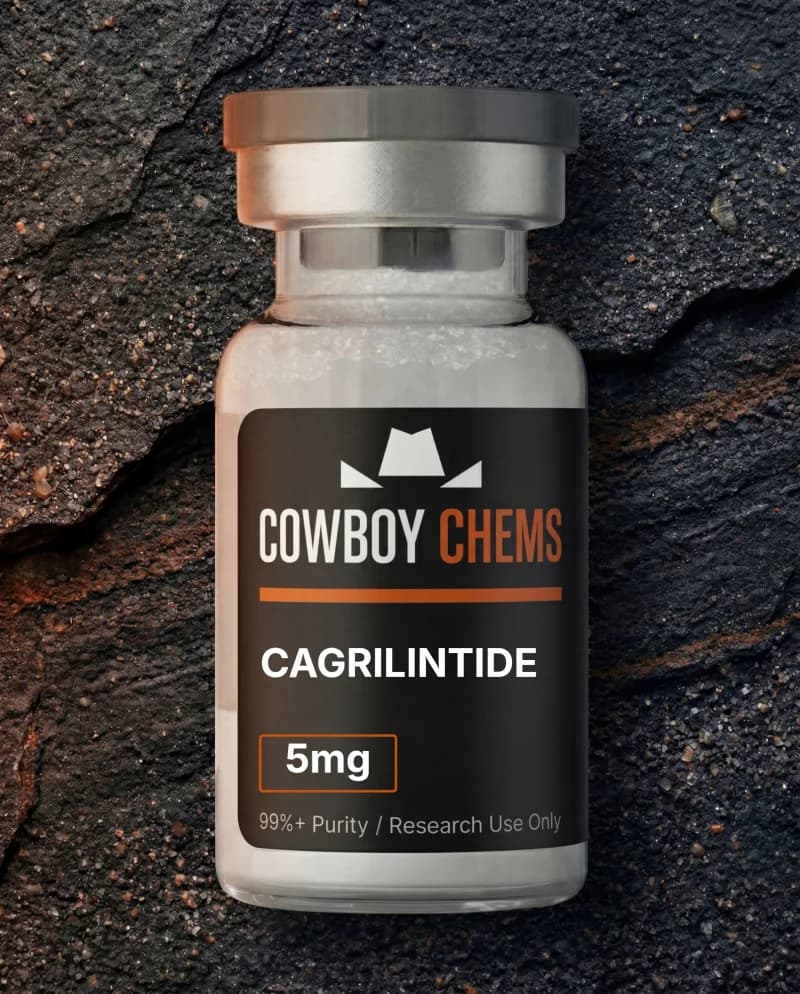
Cagrilintide is a synthetic, long-acting amylin analog studied in research for its activity at the amylin receptor complex — a distinct metabolic receptor system from the GLP-1 or GIP receptors that define the incretin class of research compounds. It is catalogued under CAS number 1415456-99-3, with a molecular formula of C₁₉₄H₃₁₂N₅₄O₅₉S₂ and a molecular weight of 4409.01 g/mol. The compound is supplied as a lyophilized powder intended solely for research purposes and is not for human use.
Cagrilintide enters the research picture as part of the broader push to characterize multi-receptor metabolic signaling. Where GLP-1 receptor agonists act on a single incretin pathway and triple agonists like retatrutide engage GLP-1, GIP, and glucagon receptors together, Cagrilintide probes an entirely separate axis — the amylin system — with a structural modification that dramatically extends its duration of activity relative to native amylin. That combination of mechanistic specificity and pharmacokinetic stability has made it a useful research tool for studying amylin receptor pharmacology and for examining what happens when amylin-pathway signaling is combined with incretin-pathway stimulation in metabolic model systems.
What is the molecular structure of Cagrilintide?
Cagrilintide is a large synthetic peptide with a molecular weight of 4409.01 g/mol and the molecular formula C₁₉₄H₃₁₂N₅₄O₅₄S₂. Its sequence is based on native human amylin (also called islet amyloid polypeptide, or IAPP) but incorporates several amino acid substitutions and a fatty acid modification that extends its half-life substantially relative to the endogenous peptide.
The fatty acid chain is the structural feature most directly associated with Cagrilintide's extended activity in pharmacokinetic research models. It promotes reversible albumin binding in biological systems, slowing renal clearance and proteolytic degradation — the same general lipidation strategy used in other long-acting metabolic research peptides. The amino acid substitutions relative to native amylin are designed in part to reduce the amyloidogenic propensity of the peptide backbone; native IAPP is prone to forming amyloid fibrils under certain conditions, and this behavior can complicate research applications. Cagrilintide is produced via solid-phase peptide synthesis with subsequent purification, and the research-grade material is characterized to 99%+ purity by HPLC.
What is the relationship between Cagrilintide and endogenous amylin?
Endogenous amylin — human IAPP — is a 37-amino acid peptide hormone co-secreted with insulin by pancreatic β-cells in response to nutrient intake. It acts on the amylin receptor complex in the brainstem and hypothalamus, contributing to postprandial satiety signaling and glucose homeostasis regulation in physiological systems. Unlike the incretin hormones GLP-1 and GIP, which are secreted from the gut, amylin originates from the pancreas and engages different central nervous system circuits in its signaling role.
Cagrilintide is engineered to activate the same amylin receptor system as endogenous IAPP while avoiding two practical limitations of native amylin in research: its very short half-life and its tendency to form amyloid aggregates. By substituting specific amino acids and attaching a fatty acid chain, Cagrilintide provides a tool for studying amylin receptor pharmacology with defined and reproducible activity in model systems. This relationship to a well-characterized endogenous signaling molecule gives Cagrilintide a mechanistically grounded research profile, distinct from synthetic peptides with no endogenous counterpart.
What does published research describe about Cagrilintide's activity at the amylin receptor?
The amylin receptor is not a simple single receptor: it is a heterodimer formed by the calcitonin receptor (CTR) paired with one of three receptor activity-modifying proteins — RAMP1, RAMP2, or RAMP3. Different pairings produce subtly different pharmacological profiles. The CTR/RAMP1 and CTR/RAMP3 combinations represent the primary amylin receptor subtypes studied in metabolic research, and published receptor pharmacology work characterizes Cagrilintide's binding affinity and potency at each subtype.
Published research describes Cagrilintide as a full agonist at the amylin receptor, with the fatty acid modification shifting the affinity and kinetic profile relative to native amylin — slower on-rate and off-rate, consistent with the albumin-binding pharmacokinetics. In vitro receptor binding assays and cyclic AMP signaling studies in receptor-expressing cell lines have been used to characterize these pharmacological properties. Central to the research interest is the fact that amylin receptor signaling engages pathways in the brainstem (area postrema) and hypothalamus that are distinct from the GLP-1 receptor circuits in the same regions — making it possible to study what changes when both systems are activated together versus individually. Cowboy Chems makes no therapeutic or outcome claims regarding Cagrilintide; it is studied for its pharmacological properties at the amylin receptor complex in research settings.
How does Cagrilintide compare to other metabolic research peptides?
The key distinction is receptor class. GLP-1 receptor agonists act on a single incretin receptor; tirzepatide (GLP-2 in CC notation) acts on GLP-1 and GIP receptors; retatrutide adds glucagon receptor activity. Cagrilintide steps outside the incretin family entirely and engages the amylin system through the calcitonin receptor heterodimer complex.
This receptor-class distinction is why Cagrilintide is studied alongside GLP-1 class compounds rather than as a substitute for them. Published research examining the CagriSema combination (Cagrilintide + semaglutide) in preclinical models uses both compounds precisely because they engage different receptor systems — the research question is whether combined stimulation of the amylin pathway and the GLP-1 pathway produces effects different from either pathway alone, which requires both tools to be present simultaneously in the model system.
What makes Cagrilintide a long-acting amylin analog in research models?
Native amylin has a very short half-life in biological systems — estimated at minutes — because it is cleared rapidly by renal filtration and subject to proteolytic degradation. This pharmacokinetic property makes native IAPP impractical as a research tool in most experimental contexts: you cannot study sustained amylin receptor engagement using a peptide that disappears from the system within minutes of application.
Cagrilintide addresses this through the fatty acid modification strategy. The attached fatty acid promotes reversible non-covalent binding to serum albumin, and that albumin association slows renal filtration and protects the peptide from rapid proteolysis. The result is dramatically extended circulating stability in pharmacokinetic model systems — hours to days rather than minutes — which makes it possible to design research experiments that examine sustained or chronic amylin receptor engagement. The amino acid substitutions in Cagrilintide's sequence, relative to native IAPP, additionally reduce the compound's tendency toward amyloid fibril formation, which removes a structural complication that would otherwise interfere with both handling and experimental interpretation. These design features together are what make Cagrilintide specifically useful as a research-grade amylin analog rather than just a purity-filtered preparation of native amylin.
What are the handling and storage requirements for Cagrilintide?
Cagrilintide is supplied as a lyophilized powder and stored at −20°C. As a lipidated peptide, it is sensitive to oxidation, thermal degradation, and moisture, as well as to the aggregation behavior that fatty-acid-conjugated peptides can exhibit under suboptimal conditions. Research handling practices that preserve compound integrity include maintaining cold storage, minimizing freeze-thaw cycling, and protecting lyophilized material from humidity during handling.
This article does not include reconstitution, preparation, or laboratory handling protocols; handling practices are determined by the researcher based on experimental requirements and applicable regulations.
How does Cowboy Chems source Cagrilintide?
Cowboy Chems supplies Cagrilintide as a research-grade compound characterized to 99%+ purity by HPLC, with mass spectrometry identity confirmation on every batch. Every batch has a batch-specific Certificate of Analysis on file as standard, not on request. Operations are entirely US-based.
Researchers can review specifications, available sizes, and pricing on the Cagrilintide product page, or browse the full metabolic research compound catalog and other categories at Browse All Compounds. For where a certificate's coverage stops, see what a COA does not tell you. All material is intended for laboratory research use only and is not for human use.
This compound is a research chemical intended for laboratory and scientific research purposes only. It is not a drug, supplement, or food, and is not intended to diagnose, treat, cure, or prevent any disease. Cowboy Chems does not sell products intended for human use. Researchers are responsible for compliance with all applicable local, state, and federal regulations.
Stay in the loop
New compounds, research updates & exclusive subscriber deals.