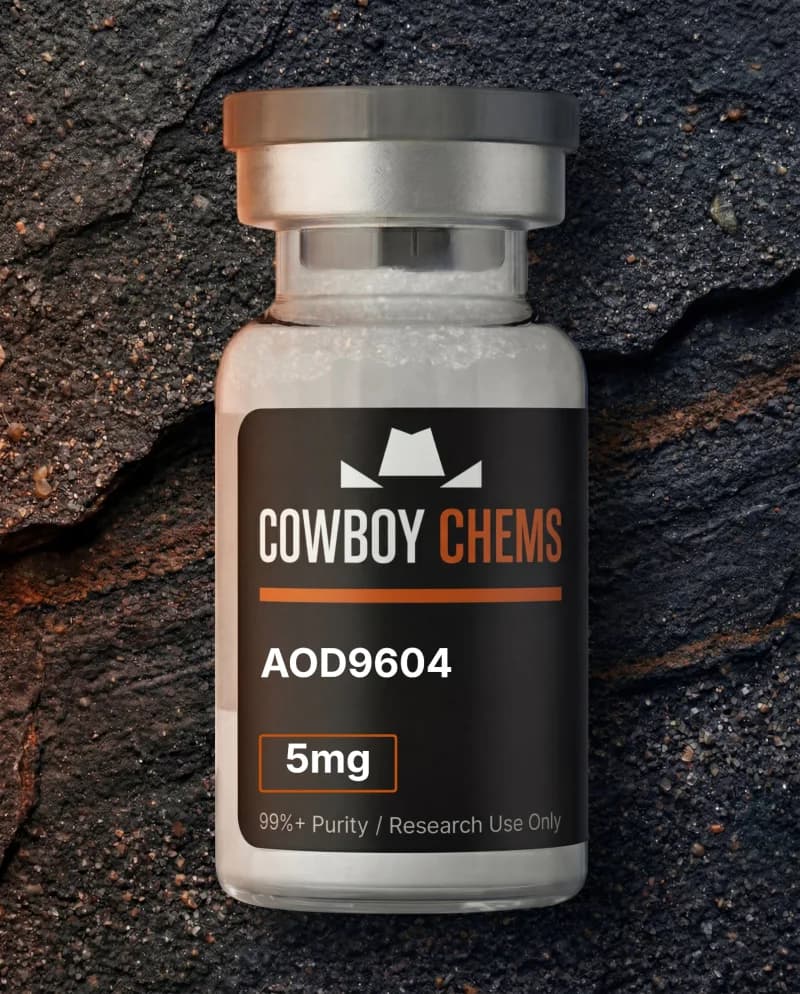
What Are Cognitive Research Peptides and Why Do These Three Matter?
Cognitive research peptides are synthetic compounds interrogated in preclinical and cell culture systems for their effects on neurotrophic signaling, receptor modulation, and synaptic biology. Semax, Selank, and Dihexa each operate through a distinct molecular target: Semax is an ACTH-derived fragment analog studied for BDNF induction; Selank is a tuftsin analog characterized as a GABA-A allosteric modulator; and Dihexa is an angiotensin IV derivative that activates HGF/c-Met receptor signaling. The three compounds do not share a mechanism — they represent three different entry points into neuropharmacology research, which is exactly what makes them useful as comparative tools. Published work on all three comes from rodent behavioral models and cell culture systems; none of these findings should be extrapolated to clinical conclusions. Cowboy Chems supplies research-grade preparations of each compound strictly for laboratory and preclinical investigation.
How Does Semax Modulate BDNF and What Does the Published Literature Show?
Semax is a synthetic heptapeptide built from adrenocorticotropic hormone fragment ACTH(4-7) with a Pro-Gly-Pro extension at the C-terminus. Full sequence: Met-Glu-His-Phe-Pro-Gly-Pro. The C-terminal extension improves metabolic stability relative to the bare ACTH(4-7) fragment and may influence receptor binding kinetics. Published research has characterized Semax's capacity to upregulate brain-derived neurotrophic factor (BDNF) in neuronal cell cultures and rodent brain tissue preparations. Ashmarin and colleagues documented Semax-induced BDNF elevation and downstream TrkB receptor activation in neuronal preparations [PMID: 16445185]. Medvedeva and colleagues investigated gene expression changes following Semax treatment in brain tissue models, identifying transcriptional effects across multiple neurotrophic pathways [PMID: 18841466]. The ACTH(4-7) core likely interacts with melanocortin receptor subtypes, with BDNF induction arising as a downstream consequence. This mechanistic profile positions Semax as a research tool for studying neurotrophin regulation in neuroprotection and cognitive function models — a distinct use case from ACTH analogs that target the adrenocortical axis directly. All Semax research applications are preclinical; Cowboy Chems supplies it for research purposes only.
What Is Selank's Anxiolytic Mechanism and How Does It Compare to Benzodiazepines?
Selank is a synthetic heptapeptide derived from tuftsin — the endogenous immunomodulatory tetrapeptide — with a Gly-Pro-Lys extension added at the C-terminus. Full sequence: Thr-Lys-Pro-Arg-Pro-Gly-Pro; molecular formula C₄₆H₇₃N₁₃O₁₃; molecular weight 1046.2 g/mol. Its published mechanism centers on allosteric modulation of GABA-A receptors — specifically, a binding interaction that differs from classical benzodiazepine sites. Kozlovskaya and colleagues characterized Selank's effects on GABA-A receptor subunit composition and chloride channel conductance in cell culture models, establishing allosteric modulation with subunit selectivity distinct from benzodiazepine binding profiles [PMID: 22786332]. Classical benzodiazepines bind the alpha/gamma subunit interface; Selank does not operate through that site. Kozlovsky and colleagues investigated additional interactions with the enkephalin system, identifying effects on opioid receptor pathways not associated with benzodiazepine activity [PMID: 22968004]. Uchakina and colleagues characterized Selank's immunomodulatory properties — modulation of interleukin expression in immune cell cultures — a dimension absent from benzodiazepine pharmacology entirely [PMID: 20717095]. In rodent anxiety models including elevated plus maze and open field paradigms, Selank has produced anxiolytic-like behavioral outcomes. These are preclinical findings from animal and cell culture systems; Selank is available from Cowboy Chems for research purposes only.
How Does Dihexa Activate HGF/c-Met Signaling and What Does That Mean for Synaptogenesis Research?
Dihexa (also designated PNB-0408) is a hexapeptide analog of angiotensin IV, engineered for potent agonist activity at the hepatocyte growth factor (HGF) / c-Met receptor complex. The angiotensin IV structural scaffold was modified to enhance binding affinity at HGF, with the compound functioning as an HGF mimetic that activates c-Met signaling independently of endogenous HGF availability. McCoy and colleagues demonstrated that Dihexa binds HGF with high affinity and transactivates c-Met in hippocampal preparations, producing synaptogenic responses in neuronal cultures [PMID: 23090578]. Bhatt and colleagues examined downstream consequences in rodent hippocampal tissue, reporting increased synaptic density markers following Dihexa treatment [PMID: 23548006]. The HGF/c-Met axis activates PI3K/Akt and MAPK/ERK cascades — pathways associated with neuronal survival signaling and dendritic spine remodeling. Wright and colleagues established the foundational characterization of the angiotensin IV binding site and its role in cognitive function in rodent models, providing context for the c-Met-directed analog development that produced Dihexa [PMID: 20888304]. Dihexa's potency at c-Met in published assays has been reported to exceed that of endogenous HGF in certain experimental formats, making it a useful pharmacological probe for synaptogenesis research. All Dihexa applications are preclinical; Cowboy Chems supplies it for research purposes only.
Comparison Table: Three Different Entry Points Into Cognitive Pathway Research
Compound
Origin
Mechanism
Receptor Target
Molecular Weight
Primary Research Application
Key PMIDs
Semax
ACTH(4-7) analog
BDNF upregulation
TrkB (indirect)
813 Da
Neuroprotection, cognitive studies
16445185, 18841466
Selank
Tuftsin analog
GABA-A modulation, enkephalin
GABA-A, opioid receptors
751 Da
Anxiolytic research, stress response
22786332, 22968004, 20717095
Dihexa
Angiotensin IV analog
HGF/c-Met agonism
c-Met
811 Da
Synaptogenesis, cognitive enhancement research
23090578, 23548006
What the Published Record Actually Shows
Semax literature converges on BDNF elevation and neuroprotective gene expression as the primary findings. Ashmarin documented BDNF induction and TrkB activation in neuronal cultures [PMID: 16445185]; Medvedeva expanded the picture with gene array data showing broader transcriptomic changes in neurotrophic networks [PMID: 18841466]. Selank literature establishes GABA-A allosteric modulation through Kozlovskaya's work [PMID: 22786332], with Kozlovsky adding enkephalin pathway interactions [PMID: 22968004]. Dihexa's HGF/c-Met transactivation and downstream synaptogenic outcomes come from McCoy and Bhatt's hippocampal studies [PMID: 23090578] [PMID: 23548006]. Across all three, findings are from cell culture systems and rodent preclinical models. The published data supports mechanistic characterization for preclinical investigation — not clinical efficacy claims. Cowboy Chems provides each compound for laboratory research only.
Frequently Asked Questions
What distinguishes Semax from other ACTH-derived peptides in research?
Semax stands apart through its C-terminal Pro-Gly-Pro extension and the secondary BDNF induction that extension enables. Most ACTH fragment analogs target melanocortin receptor subtypes and modulate stress-axis signaling with adrenocortical consequences. Semax's published profile shows indirect TrkB activation through BDNF upregulation — a property not consistently documented for other ACTH fragment analogs such as ACTH(1-24) or alpha-MSH [PMID: 16445185]. Medvedeva's gene expression work further distinguishes Semax by documenting broad neuroplasticity-related transcriptional changes that go beyond the adrenocortical axis effects associated with other ACTH-derived peptides [PMID: 18841466]. Semax is available from Cowboy Chems for research purposes only.
How is Selank's mechanism of action different from synthetic benzodiazepines in research models?
The primary difference is the binding site and the secondary pharmacology. Benzodiazepines bind the alpha/gamma subunit interface of GABA-A receptors, producing positive allosteric modulation and increased chloride conductance through a well-characterized mechanism. Selank's GABA-A interaction, established by Kozlovskaya, is described as allosteric modulation with a subunit selectivity profile distinct from benzodiazepine binding [PMID: 22786332]. Beyond GABA-A, Selank engages enkephalin system pathways that benzodiazepines do not [PMID: 22968004] and carries tuftsin-derived immunomodulatory properties — including effects on interleukin expression — that have no benzodiazepine equivalent [PMID: 20717095]. For research designs requiring GABA-A modulation without full benzodiazepine receptor occupancy or with an immunomodulatory component, Selank offers a distinct pharmacological profile.
What is the significance of HGF/c-Met signaling in Dihexa research?
HGF/c-Met is a receptor tyrosine kinase pathway that regulates neuronal survival, synaptic plasticity, and axonal architecture in the central nervous system. Dihexa's value in research is its ability to activate this pathway potently and selectively, functioning as an HGF mimetic that does not require endogenous HGF availability. McCoy and colleagues showed picomolar-affinity HGF binding and direct c-Met phosphorylation in hippocampal preparations [PMID: 23090578]. Downstream activation of PI3K/Akt and MAPK/ERK places HGF/c-Met at the intersection of neuronal survival and structural plasticity. Bhatt's reports of increased synaptic density markers following Dihexa treatment in rodent hippocampal tissue [PMID: 23548006] make it a useful tool for studies examining how synaptic remodeling responds to c-Met stimulation. All Dihexa use is for preclinical research only.
How do researchers measure BDNF changes in Semax studies?
Published Semax research employs several parallel approaches. ELISA quantifies BDNF concentrations in conditioned cell culture media, tissue homogenates, and cerebrospinal fluid fractions from rodent models. Quantitative PCR measures BDNF mRNA transcripts in neuronal preparations and brain tissue sections, capturing transcriptional induction across treatment conditions. Immunohistochemistry with anti-BDNF antibodies localizes expression changes spatially in specific brain regions including hippocampus and cortex. Western blotting confirms mature BDNF protein alongside precursor proBDNF in tissue lysates. TrkB phosphorylation assays — phospho-TrkB ELISA and co-immunoprecipitation — confirm downstream receptor activation, as established in Semax studies by Ashmarin and colleagues [PMID: 16445185]. Medvedeva also applied gene expression arrays to capture broader transcriptomic responses [PMID: 18841466]. All measurement approaches are applied in preclinical or in vitro contexts.
What research models are used to study Selank's anxiolytic properties?
Rodent behavioral paradigms provide the primary readout. The elevated plus maze quantifies anxiolytic-like behavior by measuring time in open versus closed arms in rats and mice. The open field test measures locomotor activity and center-zone exploration, which correlate with anxiety state. Kozlovskaya and Kozlovsky used neurochemical endpoints alongside behavioral measures — GABA-A receptor binding assays and enkephalin peptide quantification — to establish mechanistic correlates of the observed behavioral changes [PMID: 22786332] [PMID: 22968004]. Stress-induced hyperthermia models assess physiological anxiolytic effects. In vitro models in neuronal cell preparations enable direct receptor binding measurements that complement the behavioral data. Uchakina's work used immune cell culture systems to characterize the immunomodulatory dimension separately from the anxiolytic mechanisms [PMID: 20717095]. All models are preclinical; Selank is supplied by Cowboy Chems for research purposes only.
All compounds listed are for research purposes only. Cowboy Chems provides research-grade peptides intended for laboratory and preclinical research. Not for human or veterinary use.
Stay in the loop
New compounds, research updates & exclusive subscriber deals.