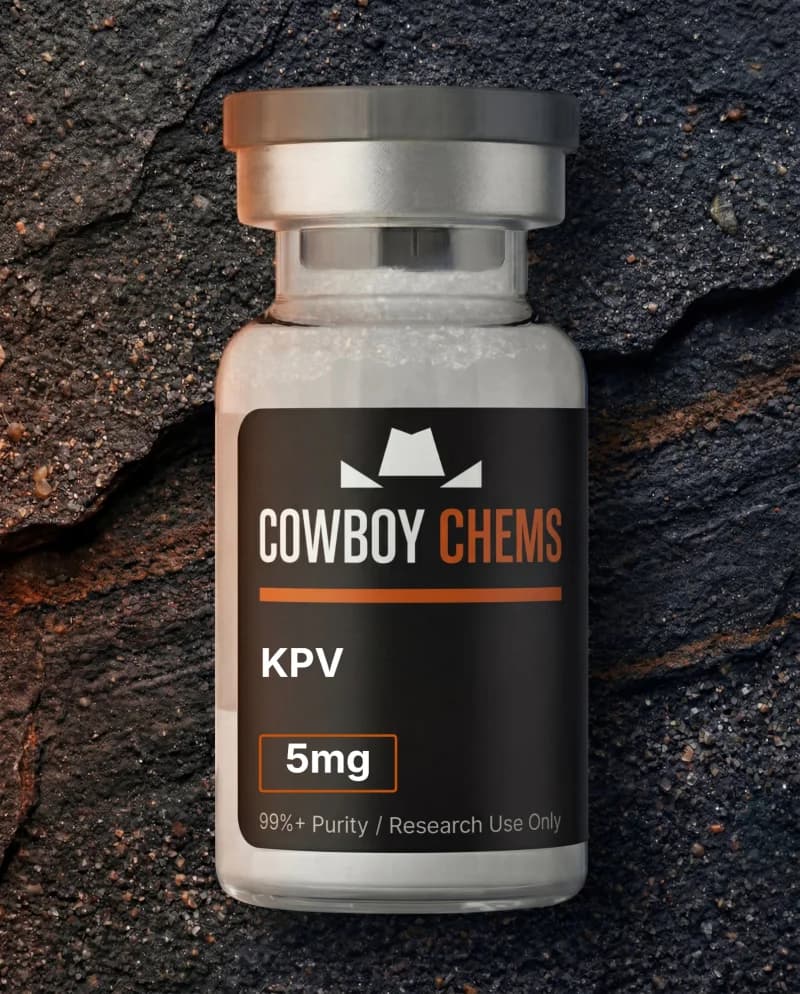
KPV is a tripeptide made of lysine, proline, and valine, written Lys-Pro-Val. In the research literature it is described as a C-terminal fragment of alpha-melanocyte-stimulating hormone (alpha-MSH), and it is studied in laboratory models of cell signaling. The Cowboy Chems catalog lists it with formula C16H30N4O4, a molecular weight of 342.43 g/mol, and CAS 67727-97-3.
It is among the smallest compounds in the research peptide catalog. With only three residues, there is very little structure to describe: no folded domain, no disulfide bridges, and no non-standard amino acids. That simplicity is what makes it a useful teaching case for how identifiers, mass, and sequence relate to one another.
What is the molecular structure of KPV?
KPV is a linear tripeptide. Its three residues are lysine at the N-terminus, proline in the middle, and valine at the C-terminus. Lysine contributes a basic side chain carrying a primary amine, proline contributes a cyclic secondary-amine backbone that restricts conformational freedom, and valine contributes a small hydrophobic isopropyl side chain.
Three residues set a hard ceiling on complexity. A tripeptide has just two peptide bonds and no secondary structure to speak of. The proline in the middle position is the one structural feature worth noting, since it introduces a fixed kink in an otherwise flexible chain.
The formula C16H30N4O4 follows from the residues. Summing lysine, proline, and valine residue masses and adding the terminal water gives a value consistent with the catalog's 342.43 g/mol. That arithmetic check, residues plus water against the listed mass, is a quick way for any reader to confirm that a listing is internally consistent.
What identifiers does the catalog list for KPV?
The Cowboy Chems catalog lists four specifications for KPV, and each can be cross-checked against the others:
Identifier
Catalog value
Sequence
Lys-Pro-Val (3 residues)
Molecular formula
C16H30N4O4
Molecular weight
342.43 g/mol
CAS registry number
67727-97-3
Stated purity
99% or higher by HPLC
Storage
-20 °C, lyophilized
Each value does a different job. The sequence defines the molecule, the formula and mass allow verification by mass spectrometry, the CAS number identifies the substance in registries and literature searches, and the purity and storage figures describe the supplied material. When all of them agree, the listing is coherent. When one is out of line, that mismatch is the first thing to investigate.
How does KPV relate to alpha-MSH?
Alpha-MSH is a longer peptide hormone, and KPV is described as corresponding to its last three residues at the C-terminal end. That origin is why KPV appears in literature about melanocortin-related signaling, even though a fragment this small is not assumed to behave like its parent. Published work typically treats the fragment as its own object of study and tests it directly.
The distinction matters when reading papers. A result reported for alpha-MSH cannot be transferred to KPV without a study that actually tested KPV, and the reverse is also true. A careful reader checks which molecule was used in each experiment and records the compound name, form, and source from the methods section instead of the abstract.
What laboratory models are used to study KPV?
The published research on KPV concerns cell and tissue models, with attention on intracellular signaling pathways such as NF-κB and on epithelial cell systems. Descriptions in the literature are about signaling readouts in those models. This overview makes no statement about effects in people or animals, and nothing in the laboratory literature should be read as one.
For a bench researcher, the practical questions are about the model and the measurement rather than the headline:
Which cell line or tissue model was used? Results in one system do not automatically carry to another.
What was the readout? Reporter assays, transcript levels, and protein measurements each answer a different question.
What was the control? A fragment study needs a scrambled or inactive peptide comparison to mean much.
Was the peptide's identity confirmed? Methods sections that report mass or purity are easier to trust than those that do not.
The catalog's own research summary for KPV is similarly modest: it describes the compound as modulating signaling in cell models and lists no published study identifiers, which is a reminder to read primary literature directly.
How does KPV compare with other catalog peptides?
Size is the clearest contrast. BPC-157 is listed at 1419.56 g/mol with formula C62H98N16O22 and CAS 137525-51-0, roughly four times the mass of KPV. GHK-Cu is another short peptide, a tripeptide-copper system listed at 340.38 g/mol for the free tripeptide with formula C14H24N6O4 and CAS 49557-75-7.
The comparison with GHK is instructive because the masses are close, 340.38 against 342.43 g/mol, even though the compounds are unrelated. Two tripeptides can differ by only a couple of mass units, which shows why a mass alone is not an identity proof. Identity needs the mass, the retention behavior, and ideally the sequence confirmed together. The catalog's SS-31 overview covers a longer peptide with a non-standard residue, where verification leans on the same set of tools in a more demanding way.
How should a KPV batch be verified?
Verification starts with the certificate of analysis and works outward. For a tripeptide, the checks are simple enough that most discrepancies are visible quickly.
Match the mass. The observed value from mass spectrometry should correspond to about 342.43 g/mol for the neutral peptide, allowing for the charge state reported.
Read the HPLC trace. A single dominant peak supports the stated purity of 99% or higher; additional peaks indicate synthesis by-products or degradation.
Check the identifiers together. Formula, mass, and CAS should agree with one another and with the registry entry.
Confirm storage handling. The catalog states -20 °C, lyophilized; records of excursions are worth keeping.
Add an independent record. Third-party testing gives a second analytical result that does not depend on the supplier's own paperwork.
Short peptides have few truncation or deletion variants, so an unexpected mass is easy to interpret. Our guide to third-party peptide testing covers how an independent analytical record is read alongside a supplier certificate.
Why does a three-residue peptide still need careful handling records?
Small does not mean trivial. A short peptide can still absorb moisture as a lyophilized powder, and a lysine side chain is a reactive amine that makes the material sensitive to its storage conditions over long periods. The catalog's storage specification, -20 °C and lyophilized, exists because the intact sequence is what a researcher is trying to study, and degradation products would be a different set of molecules.
Good records turn that into something checkable. A lab notebook entry for a tripeptide should state the catalog identifiers, the lot, the date received, where the material was held, and which analytical result was used to confirm it. If a later experiment gives an unexpected result, those entries let the researcher rule material identity in or out before looking at the biology.
The same record also supports comparisons across papers. When two studies report different outcomes for what is nominally the same peptide, the first thing to compare is how each confirmed the identity and purity of its material. Many apparent disagreements in small-peptide literature come down to differences in the material or the model rather than to the molecule itself.
What are the limits of what is known about KPV?
The honest summary is that KPV is a small, well-defined molecule with a modest, laboratory-model literature. Its structure is simple and its identifiers are checkable. What it does in any system beyond those models is outside the scope of this overview, and nothing here should be taken as a claim about it.
For researchers working independently, that is a reason to rely on primary sources, record exactly what was tested, and keep identifier checks as a routine step rather than an afterthought.
Research-use disclaimer
KPV and all other compounds referenced here are supplied by Cowboy Chems for in vitro and laboratory research purposes only. They are not drugs, supplements, or foods, and they are not intended for human or veterinary use. Nothing in this article describes a use, a recommendation, or an expected outcome in people or animals. The summaries above describe published laboratory findings in general terms and are not a substitute for reading the original papers.
Reference
Common questions
KPV is a tripeptide with the sequence lysine-proline-valine, described in the literature as a C-terminal fragment of alpha-melanocyte-stimulating hormone. The Cowboy Chems catalog lists it with formula C16H30N4O4, molecular weight 342.43 g/mol, and CAS 67727-97-3. It is studied in laboratory models only and is sold for research purposes only.
The Cowboy Chems catalog lists KPV with the molecular formula C16H30N4O4, a molecular weight of 342.43 g/mol, and CAS registry number 67727-97-3. These values should agree with each other and with a batch certificate of analysis. A listing whose numbers conflict should be resolved before any laboratory work. For research purposes only.
KPV has three residues and a mass near 342 g/mol, whereas BPC-157 is a much larger peptide listed at 1419.56 g/mol. The size difference changes how identity is verified: a small tripeptide gives a simple mass spectrum and few possible truncation products. Both are supplied for research purposes only.
Compare the certificate of analysis against the catalog identifiers: the observed mass should match about 342.43 g/mol, and the HPLC trace should show one dominant peak. Because a tripeptide has few sequence variants, mass and retention comparisons are informative. Independent third-party testing adds a second record. For research purposes only.
Stay in the loop
New compounds, research updates & exclusive subscriber deals.