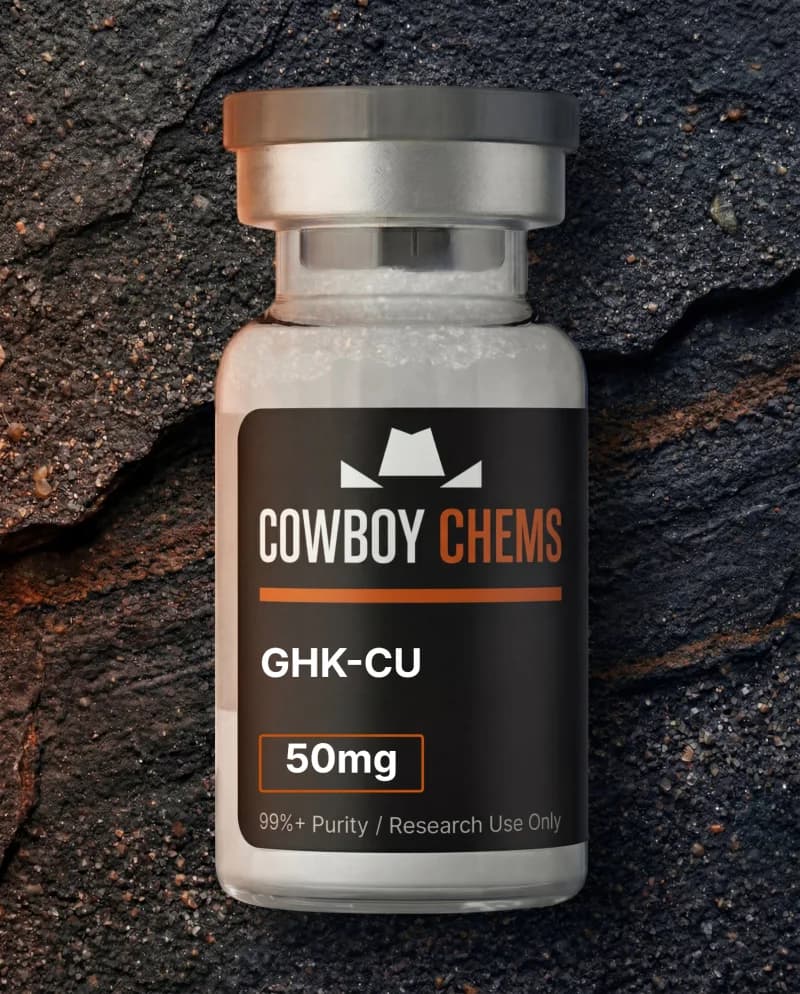
GHK-Cu is a naturally occurring copper-binding tripeptide studied in research for its role in fibroblast biology, antioxidant enzyme regulation, and tissue-repair cell culture models. The GHK portion — Glycine-Histidine-Lysine — is a tripeptide that was first isolated from human plasma in the early 1970s; the "Cu" designation indicates the copper(II) ion that forms a stable coordination complex with the peptide. It is catalogued under CAS number 49557-75-7, with a molecular formula of C₁₄H₂₄N₆O₄ (free tripeptide) and a molecular weight of 340.38 g/mol (free tripeptide) or approximately 403 g/mol for the copper complex. The compound is supplied as a lyophilized powder intended solely for research purposes and is not for human use.
What distinguishes GHK-Cu from most synthetic research peptides is its origin: it is not an engineered molecule but a sequence found naturally in human plasma, saliva, and urine, where it functions as both a signaling molecule and a copper-transport vehicle. The copper coordination is not incidental to GHK-Cu's research profile — it is central to it. Research on GHK and research on GHK-Cu are not interchangeable; the copper-bound form and the free peptide behave differently in biological model systems.
What is the molecular structure of GHK-Cu?
GHK is a three-amino-acid linear peptide: Glycine at the N-terminus, Histidine at position 2, and Lysine at the C-terminus. In its free tripeptide form the molecular weight is 340.38 g/mol and the formula is C₁₄H₂₄N₆O₄. In the copper complex, a single Cu(II) ion coordinates with the peptide, and the molecular weight shifts to approximately 403 g/mol for the resulting complex.
The copper coordination geometry in GHK-Cu is square planar, involving the N-terminal amine nitrogen, the deprotonated amide nitrogen of the Gly-His peptide bond, and the imidazole nitrogen of the histidine side chain. This coordination motif — sometimes called an ATCUN-type (amino terminal copper and nickel) complex — creates a high-affinity, well-defined copper binding site. The lysine residue at the C-terminus contributes to the overall charge character of the molecule and influences its behavior at cell membranes and extracellular matrix components. GHK-Cu is supplied at 99%+ purity by HPLC — the highest purity specification in the Cowboy Chems healing compound catalog — with mass spectrometry identity confirmation confirming both the peptide sequence and the copper coordination on every batch.
What is the biological origin of GHK-Cu?
GHK was first identified as an active fraction isolated from human plasma albumin during research into plasma-derived factors affecting liver cell behavior. Later work established GHK as a circulating tripeptide found in multiple biological fluids — plasma, saliva, and urine — and documented that its plasma concentration follows a pattern associated with age, with higher concentrations observed in younger individuals and declining levels in aged populations in published surveys.
This endogenous character gives GHK-Cu a different research framing than a synthetic-only compound. Because the peptide sequence and its copper-coordination behavior are documented in human biological fluids, published research can situate findings in the context of a naturally occurring signaling molecule rather than a wholly artificial construct. The copper delivery function adds a second layer to this framing: copper is an essential cofactor for multiple enzyme systems, including superoxide dismutase and lysyl oxidase, and peptide-mediated copper transport to specific cellular compartments is a research area in its own right.
What does published research describe about GHK-Cu and fibroblast activity?
Fibroblast biology is the most developed research area for GHK-Cu. Published cell culture work documents multiple dimensions of fibroblast response to GHK-Cu treatment, including proliferation, migration, collagen synthesis, and extracellular matrix remodeling through matrix metalloproteinases (MMPs).
Collagen synthesis is a recurring readout: GHK-Cu treatment of dermal fibroblast cultures in published studies is associated with increased collagen type I and type III production relative to untreated controls, mediated in part through TGF-β signaling pathway modulation. Fibroblast migration studies — typically scratch assay wound closure models — show accelerated coverage in GHK-Cu treated cultures. Matrix metalloproteinase research adds a remodeling dimension: GHK-Cu is studied in the context of MMP-1 (collagenase) and MMP-2 (gelatinase A) activity regulation, which affects how the extracellular matrix is degraded and reorganized during cellular repair processes. Together, these fibroblast studies position GHK-Cu as a compound relevant to research programs examining connective tissue cell biology, extracellular matrix dynamics, and the cellular mechanisms underlying tissue organization and repair in model systems. Cowboy Chems makes no therapeutic or outcome claims regarding GHK-Cu; it is studied for its effects on these cellular mechanisms in research settings.
What antioxidant and stress-response pathways is GHK-Cu studied in connection with?
The copper coordination in GHK-Cu connects it directly to antioxidant research. Copper is a cofactor for copper-zinc superoxide dismutase (Cu/Zn-SOD), one of the primary intracellular enzymes responsible for dismutating superoxide radicals. Published research describes GHK-Cu in the context of SOD activity and expression in cell culture models, with the copper delivery function providing a mechanism for how the compound influences antioxidant enzyme activity in cellular systems.
Catalase — a peroxisomal enzyme that decomposes hydrogen peroxide — is also studied in connection with GHK-Cu treatment in oxidative stress cell culture models. Published work has used reactive oxygen species (ROS) quantification assays and antioxidant enzyme expression panels to characterize GHK-Cu's effects on cellular redox status in fibroblast and epithelial cell preparations. Heat shock protein expression — specifically HSP70 — has been examined in cellular stress models, consistent with GHK-Cu's broader engagement of stress-response pathways. Beyond direct antioxidant enzyme effects, published research using gene expression analysis has documented that GHK-Cu influences a wide range of cellular pathways in model systems, including genes associated with DNA repair, proteasome function, and mitochondrial activity, suggesting a broad regulatory footprint beyond the fibroblast and antioxidant readouts that dominate the literature.
How does GHK-Cu compare to other tissue-repair research peptides?
The defining difference between GHK-Cu and other healing-category peptides is the copper coordination. BPC-157 and TB500 are purely peptide-based compounds; their biological activity comes entirely from the peptide sequence interacting with protein receptors and intracellular signaling machinery. GHK-Cu is both a peptide signal and a copper-delivery vehicle, and those two functions are not separable in its research profile — the coordination chemistry and the peptide sequence contribute together to what cell culture models respond to.
Property
GHK-Cu
BPC-157
TB500
Structure
Tripeptide + Cu(II)
15-amino acid synthetic peptide
Synthetic Tβ4 actin-binding fragment
Primary mechanism
Copper delivery + fibroblast signaling
NO pathway, growth factor signaling
Actin regulation, cell migration
Key research area
Fibroblast biology, antioxidant pathways
Gastric, vascular, neuronal models
Cytoskeletal dynamics, tissue-repair models
MW
~403 g/mol (Cu complex)
1419.56 g/mol
868.99 g/mol
Purity (CC)
99%+
99%+
99%+
For how BPC-157 sits relative to this and other compounds in the tissue repair research category, see BPC-157 and related tissue repair peptides. These compounds are studied separately and together in tissue-repair research because their mechanistic profiles are complementary — they address different cellular processes that collectively describe the biology of connective tissue and cell behavior in repair model systems.
What are the handling and storage requirements for GHK-Cu?
GHK-Cu is supplied as a lyophilized powder and stored at −20°C. As a copper-coordinated tripeptide, it has handling considerations slightly different from purely organic peptides: the copper complex is sensitive to reducing agents that can strip the Cu(II) ion, and to conditions that promote oxidation of the copper to Cu(I), which alters the coordination chemistry. Protecting the lyophilized material from moisture and oxidizing conditions is relevant to preserving the copper complex in its characterized form.
Freeze-thaw stability is generally good for small peptides like GHK-Cu compared to larger, more structurally complex compounds, but routine good practice — minimizing unnecessary freeze-thaw cycles and maintaining cold storage — applies. This article does not include reconstitution, preparation, or handling protocols beyond storage; laboratory handling practices are determined by the researcher based on experimental requirements and applicable regulations.
How does Cowboy Chems source GHK-Cu?
Cowboy Chems supplies GHK-Cu as a research-grade compound characterized to 99%+ purity by HPLC, with mass spectrometry identity confirmation verifying both the peptide sequence and the copper coordination on every batch. Every batch has a batch-specific Certificate of Analysis on file as standard. Operations are entirely US-based.
Researchers can review specifications, available sizes, and pricing on the GHK-Cu product page, or browse the full catalog of healing-category research compounds and other categories at Browse All Compounds. For where a certificate's coverage stops, see what a COA does not tell you. All material is intended for laboratory research use only and is not for human use.
This compound is a research chemical intended for laboratory and scientific research purposes only. It is not a drug, supplement, or food, and is not intended to diagnose, treat, cure, or prevent any disease. Cowboy Chems does not sell products intended for human use. Researchers are responsible for compliance with all applicable local, state, and federal regulations.
Stay in the loop
New compounds, research updates & exclusive subscriber deals.