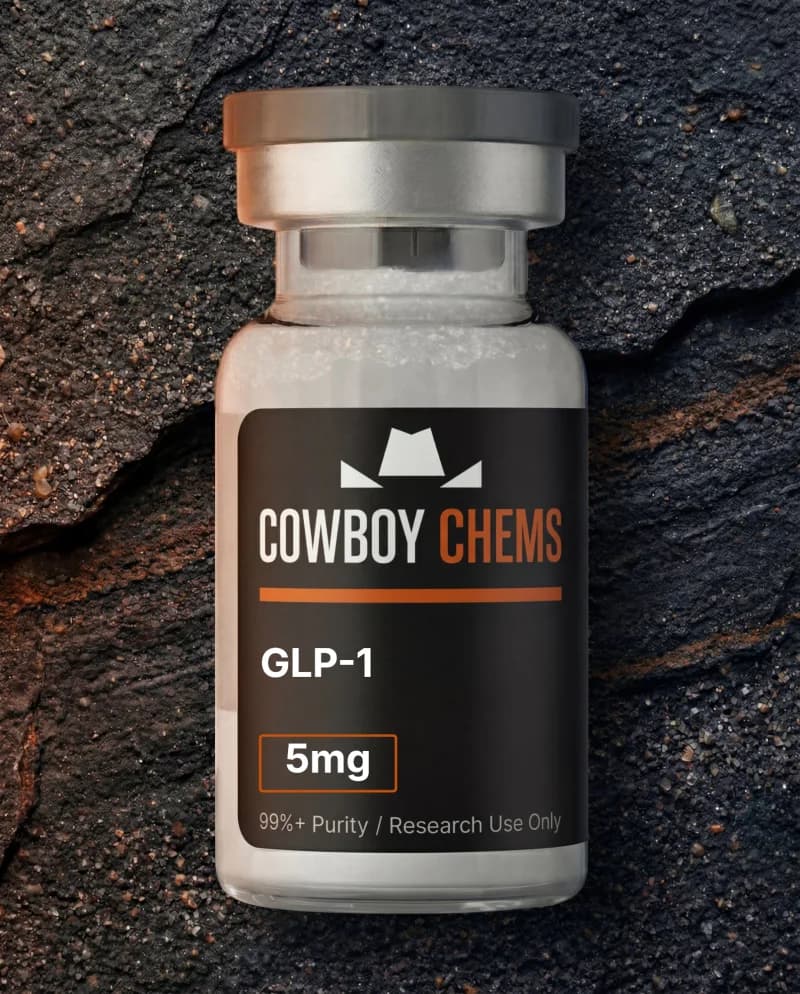
What is the GLP-1 receptor and how does it function?
The glucagon-like peptide-1 receptor (GLP-1R) is a class B G-protein coupled receptor expressed primarily in pancreatic beta cells, with lower but documented expression in the brain, heart, and gastrointestinal tract. Seven transmembrane helices anchor the receptor in the cell membrane, and it couples predominantly to Gs-proteins — triggering adenylate cyclase and raising intracellular cyclic AMP (cAMP) when a ligand binds. Published crystallography has resolved the receptor architecture in detail: an extracellular N-terminal domain that engages peptide ligands, the seven-helix transmembrane bundle, and intracellular loops that interface with G-proteins. The natural ligand is GLP-1(7-36)amide, a 30-residue peptide secreted by intestinal L-cells when nutrients arrive in the gut. Receptor activation produces glucose-dependent insulin secretion, glucagon suppression, and gastric emptying delay through a cascade of downstream signaling events. Cell culture models have also documented GLP-1R internalization after agonist binding, with trafficking patterns that differ between ligands and influence how long each agonist sustains receptor signaling. The mechanistic data comes primarily from pancreatic beta cell lines and primary islet preparations.
What is the molecular structure of native GLP-1?
Native GLP-1 circulates in two equipotent forms — GLP-1(7-36)amide and GLP-1(7-37). The predominant form is the 30-residue amidated peptide: His-Ala-Glu-Gly-Thr-Phe-Thr-Ser-Asp-Val-Ser-Ser-Tyr-Leu-Glu-Gly-Gln-Ala-Ala-Lys-Glu-Phe-Ile-Ala-Trp-Leu-Val-Lys-Gly-Arg-NH2. Molecular formula C₁₄₉H₂₂₆N₄₀O₄₅, molecular weight 3297.7 Da. NMR studies in membrane-mimetic environments show GLP-1 adopts an alpha-helical conformation, particularly across residues 13-30 at the C-terminal end of the sequence — and that helical geometry is what drives receptor engagement. The N-terminus stays more flexible, but histidine at position 7 is non-negotiable for activity. The stability problem with native GLP-1 is fundamental: circulating half-life runs 1-2 minutes because dipeptidyl peptidase-4 (DPP-4) cleaves the Ala8-Glu9 bond almost immediately, and renal clearance takes care of whatever escapes. That instability is not a bug in the published science — it is the reason the entire analog development field exists. Published pharmacokinetic analyses frame DPP-4 sensitivity and rapid renal clearance as the central constraints that analog design has to solve.
How do GLP-1 receptor agonists activate the receptor?
Agonists engage both the extracellular N-terminal domain and the transmembrane regions of GLP-1R, and that dual-site binding initiates a conformational cascade. FRET and BRET assay data from published research shows that agonist binding drives outward displacement of transmembrane helix 6, opening an intracellular cavity where the Gs-protein docks. Activated Gs stimulates adenylate cyclase, which converts ATP to cAMP. The cAMP spike activates protein kinase A (PKA) and the exchange protein Epac, and both of these phosphorylate downstream effectors including voltage-gated calcium channels and proteins governing intracellular calcium release. In pancreatic beta cells, this sequence amplifies insulin secretion in a glucose-dependent manner. Receptor activation also kicks off internalization through clathrin-mediated endocytosis, routing to early endosomes, with different agonists producing different trafficking kinetics and recycling patterns. Confocal microscopy studies in HEK293 cells expressing fluorescent GLP-1R confirm that certain analogs continue generating signals from endosomal compartments after surface internalization — which has implications for how duration of action is interpreted in signaling assay data.
What structural modifications create stable GLP-1 analogs?
Making GLP-1 useful in research applications requiring sustained receptor activation means solving the DPP-4 and renal clearance problems. Published structure-activity studies have converged on a set of modifications that work. Position 8 substitutions — glycine or aminoisobutyric acid (Aib) replacing alanine — block the DPP-4 cleavage site and extend half-life from minutes to hours. Fatty acid side chains attached at lysine 26 (a C18 di-acid in semaglutide's case) enable reversible albumin binding, building a circulating depot that releases active peptide over an extended time window. Position 34 modifications stabilize the molecule structurally. C-terminus modifications — amidation, chain truncation — fine-tune receptor affinity without disrupting the core binding interaction. Larger fusion strategies that attach immunoglobulin Fc domains reduce renal clearance through increased molecular size. Published structural analyses confirm that these modifications maintain the alpha-helical geometry required for receptor binding while layering on resistance to proteolytic enzymes and lowered clearance rates. X-ray crystallography shows the modified analogs docking at GLP-1R in the same binding pose as native GLP-1.
What is tirzepatide and how does it differ from GLP-1 agonists?
Tirzepatide is a 39-amino acid synthetic peptide built on the native GIP sequence, with 20 amino acid substitutions that also confer GLP-1R affinity — making it a dual agonist at both GIP and GLP-1 receptors rather than a selective GLP-1 agent. The structure carries a C20 fatty di-acid chain at lysine 20 for albumin binding, modifications at positions 2 and 13, and two disulfide bridges that stabilize the overall architecture, pushing half-life to approximately 5 days. Published research demonstrates that hitting both receptors simultaneously produces metabolic effects that differ from either single-receptor compound alone. Cryo-electron microscopy shows tirzepatide binding both receptors with high affinity while exhibiting signaling bias — generating greater cAMP output relative to beta-arrestin recruitment compared to native peptides. Pharmacology studies in cells co-expressing GIPR and GLP-1R document balanced agonist activity at both targets. The mechanistic distinction matters for experimental design: GIP and GLP-1 pathways are complementary but not redundant, which is what makes tirzepatide a different pharmacological tool rather than simply a more potent GLP-1 agonist.
What receptor signaling pathways do GLP-1 agonists engage?
The canonical Gs-cAMP pathway is the primary story, but not the complete one. Pathway-selective assay data confirms that different GLP-1 analogs produce distinct signaling profiles — some are biased agonists that favor cAMP production over beta-arrestin recruitment in a way that shapes downstream biology. The core sequence: Gs activation drives adenylate cyclase, cAMP rises, PKA and Epac activate, voltage-gated calcium channels phosphorylate, and calcium influx amplifies insulin secretion in glucose-stimulated beta cells. PKA also hits nuclear transcription factors including CREB, feeding back into gene expression. Beta-arrestin recruitment after receptor phosphorylation pushes internalization and can activate secondary cascades including MAP kinase pathways. In some cell types, GLP-1R activation drives phospholipase C, generating IP3 and DAG and mobilizing intracellular calcium through a PKC-dependent route. Src family kinases mediate transactivation of EGF receptor and other receptor tyrosine kinases downstream of GLP-1R stimulation. The sum of these parallel pathways is a mechanistic complexity that explains the varied phenotypes documented across different preclinical models.
How does semaglutide differ structurally from native GLP-1?
Semaglutide shares 94% sequence identity with native GLP-1 and extends circulating half-life from minutes to approximately one week through three targeted modifications, detailed in published crystallography and structure-activity work. Position 8: aminoisobutyric acid (Aib) replaces alanine, blocking the DPP-4 cleavage site and eliminating that degradation route. Lysine 26: a C18 fatty di-acid side chain attaches via a glutamate-based linker incorporating two 8-amino-3,6-dioxaoctanoic acid spacers, enabling tight but reversible albumin binding and creating the circulating depot. Position 34: arginine replaces lysine, adding structural stability. The C-terminus truncates at position 31. Published mass spectrometry confirms molecular formula C₁₈₇H₂₉₁N₄₅O₅₉ and molecular weight 4113.6 Da. Circular dichroism confirms the modifications preserve the alpha-helical architecture that drives GLP-1R engagement. X-ray crystallography places semaglutide in the same receptor binding pose as native GLP-1 — the modifications extend duration and resist degradation without changing how the molecule interacts with its target.
What applications do GLP-1 receptor agonists have in research?
GLP-1 receptor agonists are working research tools for dissecting metabolic pathways, GPCR pharmacology, and cellular signaling. Published applications include glucose-stimulated insulin secretion studies in isolated pancreatic islets and beta cell lines, receptor internalization and trafficking kinetics work using fluorescent ligand probes, and GPCR pathway characterization via pathway-selective assays. The incretin effect — the greater insulin response to oral versus intravenous glucose — is an active research area using these compounds as mechanistic probes. Neuroscience groups explore GLP-1R expression in the brain, with published work examining receptor-mediated effects in neuroprotection and synaptic function models. Cardiovascular research uses GLP-1 agonists to study endothelial function and cardiac tissue responses. Obesity research applies them to satiety signaling and energy expenditure pathway investigations. Structure-activity relationship studies map which specific structural features determine receptor affinity, signaling bias, and metabolic stability — useful context for anyone selecting between analogs for a specific research application. All of these applications require high-purity compounds with documented analytical characterization.
How do researchers study GLP-1 receptor binding?
Radioligand binding assays, fluorescence polarization, and surface plasmon resonance are the primary published protocols for GLP-1R binding characterization. [125I]-labeled GLP-1 and fluorescent analogs are used to measure receptor-ligand interactions in membrane preparations from cells expressing recombinant GLP-1R. Saturation binding experiments establish receptor density (Bmax) and equilibrium dissociation constant (Kd); competition binding assays determine agonist affinity and selectivity across receptor subtypes. Fluorescent ligand approaches enable real-time binding kinetics and receptor localization by confocal microscopy. BRET assays track receptor conformational shifts and G-protein coupling kinetics in living cells. At the structural level, cryo-electron microscopy and X-ray crystallography have resolved receptor-ligand complexes at atomic resolution, mapping the binding pose and interaction networks that govern agonist activity. These structural studies require high-purity compounds with verified sequences — sequence errors or modifications introduced by poor synthesis quality will produce misleading binding data. All applications focus on characterizing molecular mechanisms, not therapeutic outcomes.
FAQ
What is the difference between GLP-1 and GIP?
GLP-1 and GIP are both incretin hormones secreted from intestinal cells, but they differ in sequence, receptor, and function. GLP-1 is 30 amino acids; GIP is 42 amino acids. They bind distinct receptors — GLP-1R and GIPR — both class B GPCRs but with different tissue distribution and signaling profiles.
How long do GLP-1 agonists remain stable in solution?
In published in-vitro work, peptide analog solutions retain stability for approximately 7-14 days at 4°C; lyophilized material is stable at -20°C for 24+ months.
What concentration is used for cell culture research?
Published in vitro studies typically use 1-100 nM concentrations for receptor activation studies. Higher concentrations (100-1000 nM) may be used for internalization or signaling pathway studies. Always verify receptor expression in your cell model.
Can GLP-1 agonists be used in combination with other compounds?
Research studies examine combination effects with other metabolic compounds. Published research includes combination studies with insulin, other receptor agonists, and metabolic modulators. Ensure compatibility and receptor cross-talk is considered in experimental design.
What controls should be included in GLP-1 research?
Published protocols recommend vehicle controls, positive controls using native GLP-1, and receptor antagonist controls to verify specific receptor-mediated effects. Include dose-response curves to determine EC50 values for your specific experimental conditions.
Research Use Only: All compounds sold by Cowboy Chems are intended exclusively for laboratory research. Not for human use. These products are not drugs, supplements, or food. Statements have not been evaluated by the FDA. Must be 21+ to purchase.
Stay in the loop
New compounds, research updates & exclusive subscriber deals.