Retatrutide is a synthetic peptide studied in research for its simultaneous agonist activity at three distinct G-protein coupled receptors: the glucagon-like peptide-1 receptor (GLP-1R), the glucose-dependent insulinotropic polypeptide receptor (GIPR), and the glucagon receptor (GCGR). This triple-receptor engagement profile sets it apart from all earlier compounds in the incretin research class — semaglutide analogs target GLP-1R alone, tirzepatide engages GLP-1R and GIPR together, and Retatrutide extends that reach by adding glucagon receptor activity as a third simultaneous target.
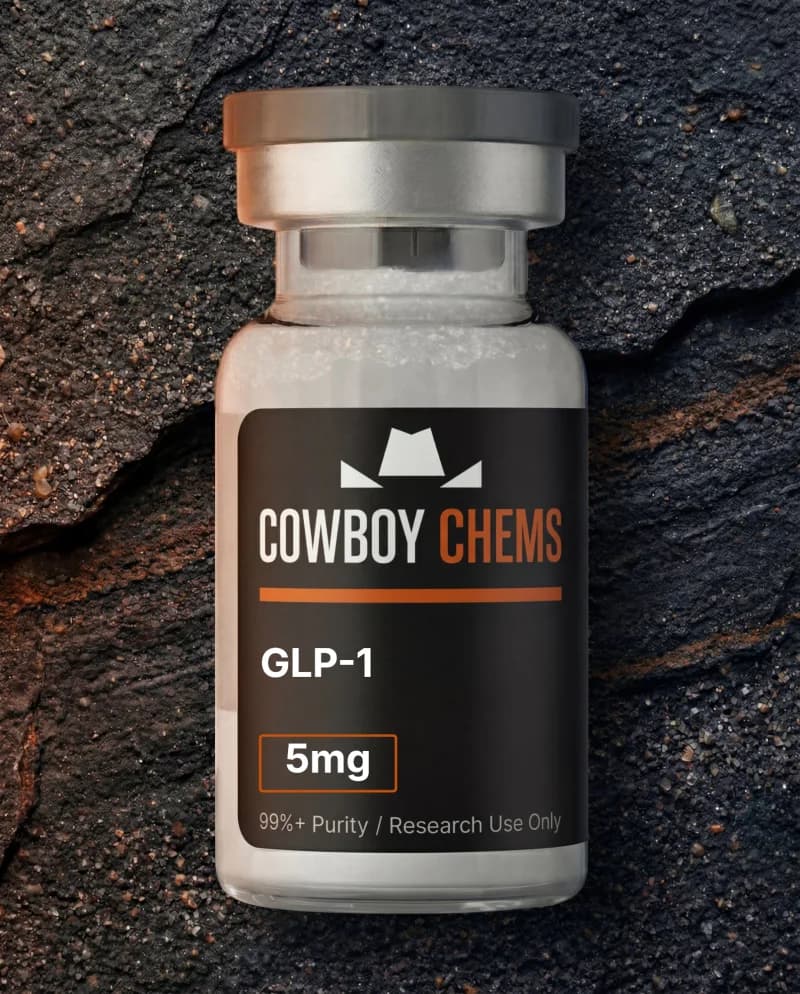
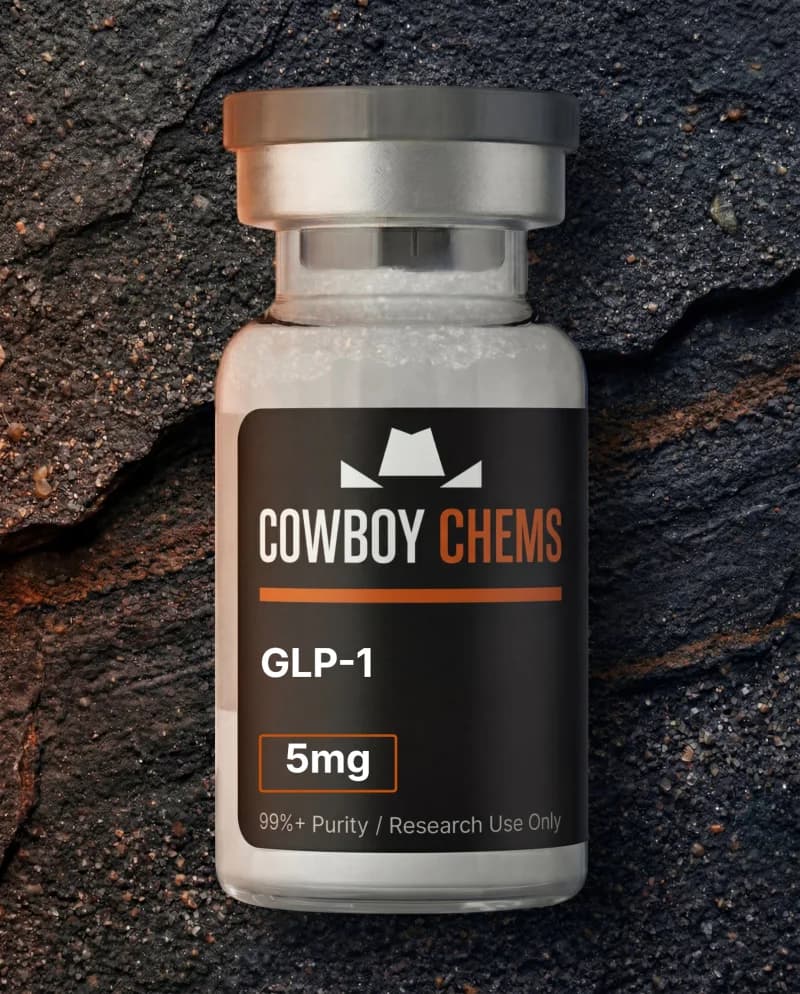
The compound is supplied as a lyophilized powder for research purposes only and is not for human use. Cowboy Chems sources it as a frontier-grade research tool specifically because its triple-agonist mechanism makes it the most pharmacologically complex compound currently available in the incretin class — which also makes it the most useful tool for researchers studying how those three receptor systems interact when activated simultaneously versus individually or in pairs.
The molecular weight is approximately 4731 g/mol, consistent with a peptide of roughly 39 amino acids bearing a fatty acid modification. The compound is sometimes referenced in published literature under the development designation LY3437943. All information in this overview is framed for research purposes only and describes receptor pharmacology, not clinical or therapeutic outcomes.
What is the molecular architecture of Retatrutide?
Retatrutide is an approximately 39-amino acid synthetic peptide, making it slightly longer than native GLP-1 (30 residues) but in the same size range as tirzepatide and other advanced incretin analogs. Its amino acid sequence is engineered from the ground up as a triple-agonist scaffold — it does not derive directly from any single endogenous peptide sequence the way GLP-1 analogs derive from native GLP-1 or amylin analogs derive from native IAPP.
The peptide carries a fatty acid side chain attached via a lysine residue, enabling reversible albumin binding that dramatically extends circulating stability relative to unmodified peptides of the same class. This lipidation strategy is shared with semaglutide and Cagrilintide, and the pharmacokinetic consequence is the same: albumin association slows renal clearance and reduces proteolytic degradation, extending circulating half-life from minutes (as it would be for a short unmodified peptide) to a multi-day range in the pharmacokinetic model systems where it has been characterized.
The sequence incorporates specific amino acid modifications at positions known to confer resistance to dipeptidyl peptidase-4 (DPP-4), the enzyme that rapidly inactivates native GLP-1 by cleaving at the N-terminus. DPP-4 resistance is a structural prerequisite for any GLP-1R agonist intended for sustained research applications. Structural analyses of triple-agonist peptides describe a helical conformation that allows the molecule to engage all three target receptors — a geometric challenge that has made triple agonism a harder engineering target than selective or dual agonism, and one that only recently became tractable in published peptide design work.
How does Retatrutide engage three receptors simultaneously?
GLP-1R, GIPR, and GCGR are all class B GPCRs, meaning they share a structural family but differ substantially at their ligand-binding domains — each evolved to recognize a distinct endogenous peptide. GLP-1R binds GLP-1; GIPR binds GIP; GCGR binds glucagon. Engineering a single peptide that engages all three with meaningful affinity is a non-trivial pharmacological problem because the three receptors have different sequence recognition requirements.
Published structure-activity work in the triple-agonist space describes a binding mechanism where the N-terminal portion of the peptide drives receptor activation and the C-terminal region governs selectivity and affinity tuning. The amino acid substitutions in Retatrutide's sequence are chosen to produce balanced agonist activity across all three receptors — not maximal affinity at any single one, but a calibrated potency profile that engages all three in the desired proportion. Published pharmacology characterizations show that Retatrutide achieves full agonism at GLP-1R and GIPR with partial-to-full agonism at GCGR, though the exact potency ratios at each receptor have been reported across multiple in vitro systems using different cell lines and assay formats, so direct comparisons across publications require attention to the experimental context.
The GCGR component is the distinctive addition relative to tirzepatide and is what makes Retatrutide's receptor pharmacology genuinely novel. Glucagon receptor signaling drives hepatic glucose production and contributes to energy expenditure modulation through distinct downstream mechanisms from the incretin receptors — mechanisms that can be studied independently using selective GCGR agonists but that Retatrutide engages simultaneously with GLP-1R and GIPR activity.
How does Retatrutide's receptor profile compare to other incretin-class compounds?
The incretin class has expanded through sequential additions of receptor targets, and Retatrutide represents the current pharmacological frontier of that expansion:
Compound
GLP-1R
GIPR
GCGR
Receptor class
Semaglutide analog
Full agonist
—
—
Single agonist
Tirzepatide
Full agonist
Full agonist
—
Dual agonist
Retatrutide
Full agonist
Full agonist
Full/partial agonist
Triple agonist
Cagrilintide
—
—
—
Amylin receptor (separate class)
Each step in this progression represents a distinct pharmacological tool, not simply a more potent version of the same mechanism. Adding GIPR activity to GLP-1R agonism changes the signaling picture because GIP and GLP-1 receptors, while both incretin-class GPCRs, are expressed in different proportions across tissues and engage overlapping but distinct downstream cascades. Adding GCGR activity introduces a third layer: glucagon receptor signaling opposes some incretin effects at the hepatic level (driving glycogenolysis and gluconeogenesis) while contributing to energy expenditure through a different mechanism in other tissue compartments.
Researchers studying incretin pharmacology use this compound class hierarchy precisely because the comparison between single-agonist, dual-agonist, and triple-agonist responses in a given model system can isolate the contribution of each receptor axis. Retatrutide is the essential tool for the GCGR contribution because no other compound in the class captures it while simultaneously engaging GLP-1R and GIPR.
What downstream signaling mechanisms does triple-receptor agonism engage?
Each of the three receptors activates adenylate cyclase through Gs-protein coupling, producing cAMP as the primary second messenger — a mechanistic feature shared across the class B GPCR family. However, the tissue distribution and downstream effector networks of the three receptors differ in ways that matter for interpreting research data.
GLP-1R activation in pancreatic beta cells drives glucose-dependent insulin secretion through cAMP-mediated potentiation of calcium influx and downstream phosphorylation cascades. Published signal transduction work also documents GLP-1R-mediated beta-arrestin recruitment, receptor internalization, and endosomal signaling — properties that vary across agonists and influence how sustained signaling is interpreted in live-cell assay data.
GIPR activation contributes to incretin-mediated insulin secretion through a parallel but non-redundant pathway. GIPR is expressed in adipose tissue in addition to pancreatic beta cells, and published receptor pharmacology work in adipose-derived cell systems documents distinct cAMP and downstream effector responses at GIPR that are not replicated by GLP-1R stimulation alone. The additive or synergistic interaction between GLP-1R and GIPR stimulation is one of the pharmacological questions that dual- and triple-agonist compounds help dissect.
GCGR stimulation in hepatocytes activates adenylate cyclase through a similar Gs-coupling mechanism, but drives glycogen phosphorylase activation and gluconeogenic enzyme expression through PKA-mediated phosphorylation — an acute pro-glucogenic response that is mechanistically opposite to the glucose-lowering effects of incretin receptor stimulation. This opposing directionality is precisely what makes it pharmacologically interesting in a triple-agonist context: published research in model systems examines whether the net balance of simultaneous GCGR + GLP-1R + GIPR stimulation produces outcomes distinct from any single-receptor or dual-receptor combination, and what the kinetics of that receptor cross-talk look like in different tissue preparations.
What does published research characterize about Retatrutide's pharmacokinetics?
Published pharmacokinetic characterizations of Retatrutide describe the fatty acid lipidation strategy as producing an extended half-life consistent with other albumin-binding incretin analogs — on the order of days in relevant model systems, in contrast to the minute-scale half-lives of native GLP-1 or glucagon. The albumin-binding mechanism is well-documented across the lipidated peptide class: the fatty acid chain forms a reversible non-covalent association with albumin's hydrophobic binding pocket, and this association dramatically reduces the fraction of free peptide available for renal filtration or proteolytic clearance at any given time.
The triple-agonist peptide backbone itself presents additional pharmacokinetic complexity relative to monospecific analogs. A longer, more heavily modified peptide sequence may exhibit different proteolytic susceptibility profiles, and the affinity of the fatty acid modification for albumin is sequence-context-dependent. Published pharmacokinetic data characterizing Retatrutide in preclinical species shows an extended half-life profile on the order of days in model systems, though direct translation across species requires attention to albumin binding affinity differences and renal clearance rate differences between model organisms.
Retatrutide is supplied as a lyophilized powder and requires cold-chain storage at −20°C. As with all lipidated research peptides, freeze-thaw cycling should be minimized to preserve compound integrity. This overview does not include preparation or laboratory handling protocols; those are determined by the researcher based on experimental requirements and applicable regulations.
Why is Retatrutide the current frontier compound in the incretin class?
The incretin research field has advanced through a clear progression from single-receptor to dual-receptor to triple-receptor tools, and each step has opened new experimental questions that the previous tier couldn't answer. Single-agonist compounds isolate GLP-1R pharmacology. Dual agonists like tirzepatide create a tool for studying the GLP-1R + GIPR interaction. Triple agonism with Retatrutide adds the GCGR variable and makes it possible to ask questions that dual agonism cannot address: What does GCGR contribution add to the dual-agonist signaling landscape? How do the net hepatic effects of simultaneous incretin and glucagon receptor stimulation compare to incretin stimulation alone? Does GCGR engagement change the dynamics of beta cell insulin secretion response when GLP-1R and GIPR are co-stimulated?
These are open research questions in published metabolic pharmacology literature, and Retatrutide is the compound that makes them experimentally tractable. Its frontier status in the class is not marketing language — it reflects a genuine gap in the pharmacological toolkit that only a molecule with verified triple-receptor agonism can fill.
From Cowboy Chems' perspective, that is exactly the kind of compound this catalog is built for: not the established compound with the longest published track record, but the mechanistically distinct one at the edge of what is currently characterizable in research. Retatrutide's triple-agonist profile, extended pharmacokinetics, and position as the current leading edge of incretin class pharmacology make it the compound that advanced metabolic signaling research programs are reaching for when tirzepatide and semaglutide analogs have already told them what they need to know about the dual- and single-agonist tiers.
How does Cowboy Chems source Retatrutide?
Cowboy Chems supplies Retatrutide as a research-grade compound, characterized to 99%+ purity by HPLC with mass spectrometry identity confirmation on every batch. A batch-specific Certificate of Analysis is on file for every batch as standard. For where a certificate's coverage stops, see what a COA does not tell you.
Researchers can review specifications, available sizes, and pricing on the Retatrutide product page, or browse the full incretin and metabolic peptide catalog at Browse All Compounds. All material is intended for laboratory research use only and is not for human use.
This compound is a research chemical intended for laboratory and scientific research purposes only. It is not a drug, supplement, or food, and is not intended to diagnose, treat, cure, or prevent any disease. Cowboy Chems does not sell products intended for human use. Researchers are responsible for compliance with all applicable local, state, and federal regulations.
Stay in the loop
New compounds, research updates & exclusive subscriber deals.