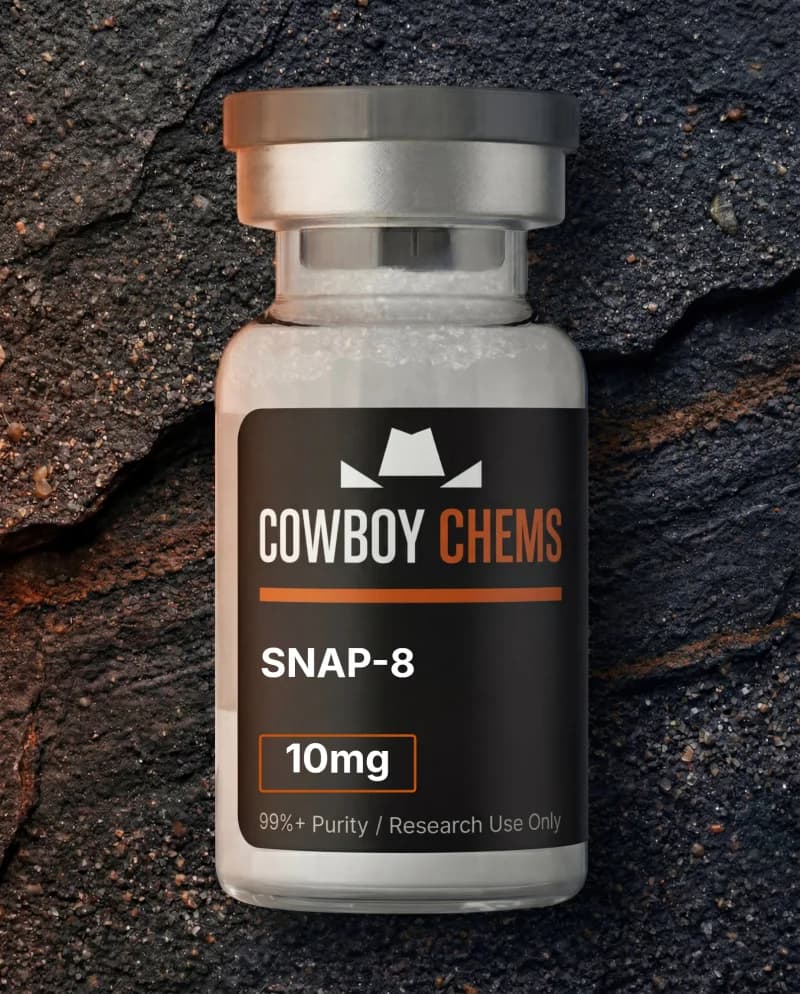
Snap-8 is a synthetic, acetylated octapeptide studied in research for its interaction with the SNARE-complex machinery that governs vesicle docking and neurotransmitter release at neuromuscular junctions. It is catalogued under CAS number 868844-74-0, with a molecular formula of C41H70N16O16 and a molecular weight of 1075.09 g/mol. The compound is supplied as a lyophilized powder intended solely for laboratory research and is not for human use.
Snap-8 belongs to a family of research peptides derived from and extending the structure of shorter acetylated hexapeptides originally developed to probe the SNARE-mediated exocytosis pathway. Its name reflects both the eight-residue length of the peptide and its research association with SNAP-25 (synaptosomal-associated protein 25), one of the core protein components of the SNARE complex that the peptide family is studied against. Extending the parent hexapeptide by two additional residues is the structural feature that distinguishes Snap-8 within this compound class, and it is the basis for most of the comparative research discussed below.
What is the molecular structure of Snap-8?
Snap-8 is an eight-amino-acid linear peptide chain that carries an acetyl group on its N-terminus and an amide group on its C-terminus — a capping pattern common across this peptide family that increases resistance to exopeptidase degradation relative to an unmodified free peptide. The molecular formula is C41H70N16O16, with a molecular weight of 1075.09 g/mol. Cowboy Chems supplies Snap-8 at 99%+ purity by HPLC, with mass spectrometry identity confirmation on every batch verifying that the observed molecular weight matches the theoretical value for the intended sequence.
The peptide's extended length relative to its six-residue predecessor increases the surface available for interaction with target protein components in research assays, which is the structural rationale cited in published research for testing whether the eight-residue form shows different binding behavior than the shorter parent compound. As with other synthetic peptides in this class, batch-to-batch consistency in sequence and acetylation/amidation completeness is what HPLC and mass spectrometry are specifically checking for, since incomplete capping at either terminus changes both the stability and the research-relevant binding properties of the molecule.
What is Snap-8 studied in relation to within SNARE-complex research?
The SNARE complex is a set of proteins — including SNAP-25, syntaxin, and VAMP/synaptobrevin — that assemble to mediate the docking and fusion of neurotransmitter-containing vesicles with the presynaptic membrane at neuromuscular junctions, the step that precedes neurotransmitter release into the synaptic cleft. Published in vitro research on the acetylated hexapeptide and octapeptide family describes these compounds as competitive inhibitors that interact with components of this docking and fusion machinery, structurally mimicking a segment of SNAP-25 and interfering with productive SNARE complex assembly.
Research on Snap-8 specifically has examined whether the two additional residues carried by the octapeptide relative to the hexapeptide translate into a measurably different interaction profile with SNARE-complex components in cell-free and cell-based assay systems. This research is mechanistic and structural in character — characterizing how the peptide engages the target machinery — rather than describing outcomes in a living organism, and Cowboy Chems makes no claims about downstream physiological or cosmetic effects associated with this mechanism.
What research models have examined Snap-8?
Published research on this peptide family has relied primarily on in vitro systems: cell-free biochemical assays examining direct interaction between the peptide and isolated SNARE-complex protein components, and cultured neuronal or neuromuscular cell models used to assess effects on regulated exocytosis and neurotransmitter release signaling. These model systems allow researchers to isolate the peptide's interaction with the docking-and-fusion machinery from the many other variables present in a whole-organism system.
Comparative research design in this space typically runs the hexapeptide and octapeptide analogs side by side in the same assay format, which is how the structure-activity relationship between chain length and inhibitory interaction has been characterized in the literature. This comparative approach is also why Snap-8 is frequently discussed alongside its shorter analog rather than in isolation — the research questions in this compound class are substantially about how the two additional residues change binding behavior relative to the established hexapeptide reference.
Assay readouts used across this research area include competitive-binding formats, where the peptide is tested against isolated SNARE-complex protein fragments to assess whether it displaces or blocks native complex assembly, and cell-based exocytosis assays, where cultured neuronal or neuromuscular cell lines are stimulated and the resulting release of marker compounds is measured with and without peptide pretreatment. Concentration-response testing across a dilution series is standard practice in this literature, allowing researchers to characterize relative potency between the hexapeptide and octapeptide analogs rather than relying on single-concentration comparisons, which would not distinguish a stronger interaction from a weaker one operating at the same tested dose.
How does Snap-8 relate to shorter acetyl hexapeptide analogs?
Snap-8 is structurally an extension of a six-residue acetylated, amidated peptide already established in the research literature as a SNARE-complex-interacting compound — the hexapeptide adds an acetyl cap and amide cap around a six-residue core, and Snap-8 extends that core by two further residues while retaining the same N-acetyl and C-amide capping pattern. This shared architecture is why the two compounds are studied within the same mechanistic framework and are frequently positioned as comparators for one another in published research examining structure-activity relationships in this peptide class.
The comparative research interest in Snap-8 is specifically whether its longer chain confers a measurably different — commonly reported as more extensive — interaction with SNARE-complex targets relative to the six-residue reference compound in the same assay systems, a question that remains an active area of structure-activity research within this peptide family.
How is Snap-8 identity and purity verified analytically?
Identity confirmation for Snap-8 relies on the same two-technique approach used across synthetic research peptides: reverse-phase HPLC for purity quantification and mass spectrometry for molecular weight confirmation. HPLC separates the target octapeptide from synthesis-related impurities — truncated sequences missing one or more of the eight residues, incompletely acetylated or amidated variants, and oxidation products — based on differences in hydrophobicity as the sample passes through a C18 column under a gradient mobile phase. The resulting purity figure is calculated as the target peptide's peak area relative to total integrated peak area.
Mass spectrometry addresses a different question: whether the dominant HPLC peak is actually Snap-8 rather than a synthesis byproduct of similar hydrophobicity that happens to co-elute at a similar retention time. Comparing the observed mass against the theoretical molecular weight of 1075.09 g/mol confirms both the correct residue count and the presence of both terminal modifications, since a missing acetyl or amide group would shift the observed mass in a predictable, detectable direction. Cowboy Chems runs both analyses on every batch and reports the results on a batch-specific Certificate of Analysis rather than a generic specification sheet.
What are the handling and storage requirements for Snap-8?
Snap-8 is supplied as a lyophilized powder and stored at −20°C. As an acetylated and amidated synthetic peptide, its degradation risk in the dry state is dominated by moisture exposure and thermal excursion rather than by the specific residue-level degradation pathways relevant to peptides with unmodified, unprotected termini — the capping chemistry that gives Snap-8 its research-relevant stability advantage over an unmodified peptide of comparable length is also what makes proper dry, cold, sealed storage worth maintaining consistently.
This article does not include reconstitution, preparation, or handling protocols beyond storage; laboratory handling practices are determined by the researcher based on experimental requirements and applicable regulations.
How does Cowboy Chems source Snap-8?
Cowboy Chems supplies Snap-8 as a research-grade compound characterized to 99%+ purity by HPLC, with mass spectrometry identity confirmation verifying the peptide's molecular weight against its theoretical value on every batch. Every batch has a batch-specific Certificate of Analysis on file as standard. Operations are entirely US-based.
Researchers can review specifications, available sizes, and pricing on the Snap-8 product page, or browse the full catalog of research compounds by category at Browse All Compounds. For where a certificate's coverage stops, see what a COA does not tell you. All material is intended for laboratory research use only and is not for human use.
This compound is a research chemical intended for laboratory and scientific research purposes only. It is not a drug, supplement, or food, and is not intended to diagnose, treat, cure, or prevent any disease. Cowboy Chems does not sell products intended for human use. Researchers are responsible for compliance with all applicable local, state, and federal regulations.
Stay in the loop
New compounds, research updates & exclusive subscriber deals.